Forest Kernel Energy Balancing for Causal Inference
forestBalance estimates average treatment effects (ATE) by combining multivariate random forests with kernel energy balancing. A joint forest model of covariates, treatment, and outcome defines a proximity kernel that characterizes the confounding structure and emphasizes similarity of observations in terms of confounding. Distributional balancing weights are then obtained via a closed-form kernel energy distance solution. By construction, these balancing weights aim to balance the joint distribution of confounders specifically.
The method is described in:
De, S. and Huling, J.D. (2025). Data adaptive covariate balancing for causal effect estimation for high dimensional data. arXiv:2512.18069.
Quick start
# library(forestBalance)

# Simulate observational data with nonlinear confounding (true ATE = 0)
set.seed(123)
dat <- simulate_data(n = 500, p = 10, ate = 0)

# Estimate ATE with forest kernel energy balancing
fit <- forest_balance(dat$X, dat$A, dat$Y)
fit
#> Forest Kernel Energy Balancing
#> --------------------------------------------------
#>   n = 500  (n_treated = 173, n_control = 327)
#>   Trees: 1000
#>   Solver: direct
#>   ATE estimate: 0.0455
#>   ESS: treated = 105/173 (61%)   control = 232/327 (71%)
#> --------------------------------------------------
#> Use summary() for covariate balance details.
How it works
The method proceeds in three steps:
Joint forest model: A
grf::multi_regression_forestis fit on covariates with the bivariate response . Because the forest splits on both treatment and outcome, the resulting tree structure captures confounding relationships.Proximity kernel: The kernel matrix is defined as the proportion of trees where observations and share a leaf node. This is computed efficiently via a single sparse matrix cross-product.
Kernel energy balancing: Balancing weights are obtained in closed form by solving a linear system derived from the kernel energy distance objective. The weights make the treated and control distributions similar with respect to the forest-defined similarity measure.
Detailed example
Simulating data
simulate_data() generates observational data with nonlinear confounding through a Beta density link:
Fitting the model
fit <- forest_balance(dat$X, dat$A, dat$Y, num.trees = 1000)Print and summary
print() gives a concise overview:
fit
#> Forest Kernel Energy Balancing
#> --------------------------------------------------
#>   n = 800  (n_treated = 275, n_control = 525)
#>   Trees: 1000
#>   Solver: direct
#>   ATE estimate: 0.0388
#>   ESS: treated = 191/275 (70%)   control = 394/525 (75%)
#> --------------------------------------------------
#> Use summary() for covariate balance details.
summary() provides a full covariate balance comparison (unweighted vs weighted) with flagged imbalances:
summary(fit)
#> Forest Kernel Energy Balancing
#> ============================================================
#>   n = 800  (n_treated = 275, n_control = 525)
#>   Trees: 1000
#>   Kernel density: 29.0% nonzero
#>
#>   ATE estimate: 0.0388
#> ============================================================
#>
#> Covariate Balance (|SMD|)
#> ------------------------------------------------------------
#>   Covariate     Unweighted      Weighted
#>   ----------  ------------  ------------
#>   X1              0.1668 *        0.0220
#>   X2              0.2956 *        0.0086
#>   X3                0.0277        0.0148
#>   X4              0.1102 *        0.0242
#>   X5                0.0430        0.0210
#>   X6                0.0189        0.0055
#>   X7                0.0945        0.0258
#>   X8                0.0733        0.0033
#>   X9                0.0332        0.0284
#>   X10               0.0734        0.0055
#>   ----------  ------------  ------------
#>   Max |SMD|         0.2956        0.0284
#>   (* indicates |SMD| > 0.10)
#>
#> Effective Sample Size
#> ------------------------------------------------------------
#>   Treated: 191 / 275  (70%)
#>   Control: 394 / 525  (75%)
#>
#> Energy Distance
#> ------------------------------------------------------------
#>   Unweighted: 0.0486
#>   Weighted:   0.0144
#> ============================================================
Balance on nonlinear transformations
Since confounding operates through nonlinear functions of and , we can check balance on transformations of the covariates:
X <- dat$X
X.nl <- cbind(
  X[,1]^2, X[,2]^2, X[,5]^2,
  X[,1] * X[,2], X[,1] * X[,5],
  dbeta(X[,1], 2, 4), dbeta(X[,5], 2, 4)
)
colnames(X.nl) <- c("X1^2", "X2^2", "X5^2", "X1*X2", "X1*X5",
                     "Beta(X1)", "Beta(X5)")

summary(fit, X.trans = X.nl)
#> Forest Kernel Energy Balancing
#> ============================================================
#>   n = 800  (n_treated = 275, n_control = 525)
#>   Trees: 1000
#>   Kernel density: 29.0% nonzero
#>
#>   ATE estimate: 0.0388
#> ============================================================
#>
#> Covariate Balance (|SMD|)
#> ------------------------------------------------------------
#>   Covariate     Unweighted      Weighted
#>   ----------  ------------  ------------
#>   X1              0.1668 *        0.0220
#>   X2              0.2956 *        0.0086
#>   X3                0.0277        0.0148
#>   X4              0.1102 *        0.0242
#>   X5                0.0430        0.0210
#>   X6                0.0189        0.0055
#>   X7                0.0945        0.0258
#>   X8                0.0733        0.0033
#>   X9                0.0332        0.0284
#>   X10               0.0734        0.0055
#>   ----------  ------------  ------------
#>   Max |SMD|         0.2956        0.0284
#>   (* indicates |SMD| > 0.10)
#>
#> Transformed Covariate Balance (|SMD|)
#> ------------------------------------------------------------
#>   Transform     Unweighted      Weighted
#>   ----------  ------------  ------------
#>   X1^2            0.2904 *        0.0259
#>   X2^2              0.0941        0.0322
#>   X5^2              0.0841        0.0694
#>   X1*X2           0.1303 *        0.0144
#>   X1*X5             0.0573        0.0582
#>   Beta(X1)        0.6847 *        0.0347
#>   Beta(X5)          0.0289        0.0138
#>   ----------  ------------  ------------
#>   Max |SMD|         0.6847        0.0694
#>
#> Effective Sample Size
#> ------------------------------------------------------------
#>   Treated: 191 / 275  (70%)
#>   Control: 394 / 525  (75%)
#>
#> Energy Distance
#> ------------------------------------------------------------
#>   Unweighted: 0.0486
#>   Weighted:   0.0144
#> ============================================================
Standalone balance diagnostics
compute_balance() can be used independently with any set of weights:
# Inverse propensity weights (using true propensity scores)
ipw <- ifelse(dat$A == 1, 1 / dat$propensity, 1 / (1 - dat$propensity))

bal_forest <- compute_balance(dat$X, dat$A, fit$weights)
bal_ipw    <- compute_balance(dat$X, dat$A, ipw)

c("Forest balance" = round(bal_forest$max_smd, 4),
  "IPW"            = round(bal_ipw$max_smd, 4))
#> Forest balance            IPW
#>         0.0284         0.2508
Lower-level interface
For more control, the pipeline can be run step by step:
library(grf)

# 1. Fit the joint forest
forest <- multi_regression_forest(dat$X, scale(cbind(dat$A, dat$Y)),
                                  num.trees = 500)

# 2. Extract leaf node matrix and build kernel
leaf_mat <- get_leaf_node_matrix(forest, dat$X)
K <- leaf_node_kernel(leaf_mat)

c("observations" = nrow(leaf_mat), "trees" = ncol(leaf_mat))
#> observations        trees
#>          800          500
c("kernel % nonzero" = round(100 * length(K@x) / prod(dim(K)), 1))
#> kernel % nonzero
#>             24.5

# 3. Compute balancing weights
bal <- kernel_balance(dat$A, K)

ate <- weighted.mean(dat$Y[dat$A == 1], bal$weights[dat$A == 1]) -
       weighted.mean(dat$Y[dat$A == 0], bal$weights[dat$A == 0])
c("ATE estimate" = round(ate, 4))
#> ATE estimate
#>       0.1455
Simulation study
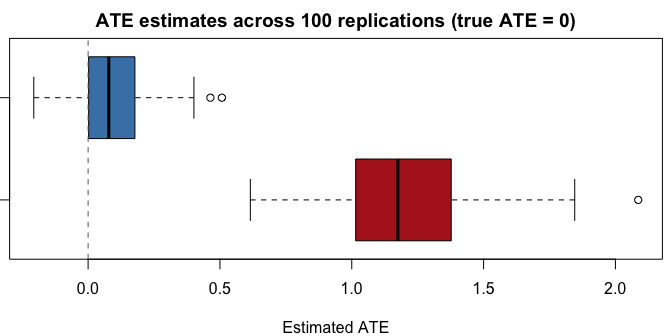
A small simulation comparing the forest balance estimator against the naive (unadjusted) difference in means:
set.seed(1)
nreps <- 100
results <- matrix(NA, nreps, 2, dimnames = list(NULL, c("Naive", "Forest")))

for (r in seq_len(nreps)) {
  dat <- simulate_data(n = 500, p = 10, ate = 0)
  fit <- forest_balance(dat$X, dat$A, dat$Y, num.trees = 500)
  results[r, "Naive"]  <- mean(dat$Y[dat$A == 1]) - mean(dat$Y[dat$A == 0])
  results[r, "Forest"] <- fit$ate
}| Method | Bias | SD | RMSE |
|---|---|---|---|
| Naive | 1.2055 | 0.2983 | 1.2419 |
| Forest | 0.0932 | 0.1428 | 0.1705 |
Key functions
| Function | Description |
|---|---|
forest_balance() |
High-level: fit forest, build kernel, compute weights, return ATE |
simulate_data() |
Simulate observational data with nonlinear confounding |
compute_balance() |
Covariate balance diagnostics (SMD, ESS, energy distance) |
get_leaf_node_matrix() |
Fast vectorized leaf node extraction from grf forests |
leaf_node_kernel() |
Sparse proximity kernel from leaf node matrix |
forest_kernel() |
Convenience: forest object to kernel in one call |
kernel_balance() |
Closed-form kernel energy balancing weights |